


For many years, the Norwegian Krone (NOK) and the Swedish Krona (SEK) exhibited a high degree of correlation, often moving in tandem against major currencies like the Euro (EUR) or the US Dollar (USD). As the two main Scandinavian currencies, their economies are deeply intertwined by trade and shared exposure to global risk sentiment. This historical correlation led many market participants to treat them as near-substitutes, with movements in the EUR/NOK pair often mirrored by the EUR/SEK pair.
However, recent economic shifts have caused a profound and sustained divergence between the two currencies. This has created a complex market dynamic where the cross-rate, NOK/SEK, has become highly volatile and fundamentally driven. For the CFD trader, this divergence presents a compelling, albeit risky, situation. It is critical to dissect whether this ongoing movement represents a potential opportunity, perhaps a form of relative value play, or if it is a persistent macro trap for those who simply bet on an immediate, historical reversion to the mean. The underlying forces impacting the Nordic economies are powerful, requiring any trader focusing on instruments like EUR/NOK CFDs or EUR/SEK CFDs to possess a disciplined, macro-informed approach rather than relying on technical correlation alone.
Access 1 000+ global CFDs instruments.
Access a plethora of trading opportunities across the financial markets.

Main Analysis: Deconstructing the Divergence
The breakdown in the NOK/SEK correlation is not random; it is rooted in significant policy and structural differences that have manifested under recent global inflationary and rate-hiking cycles. Understanding these drivers is the first step in avoiding the macro trap.
1. Interest Rates and Central Bank Policy
The most immediate and impactful driver of the divergence is the different paths taken by their respective central banks: Norges Bank (NB) in Norway and the Riksbank (RB) in Sweden.
The Norges Bank Stance : Norges Bank often tends to take a more proactive and sustained hawkish stance. Norway’s economy is fundamentally underpinned by its vast oil and gas sector, and its massive sovereign wealth fund (the Government Pension Fund Global). This structural wealth tends to provide the central bank with a greater degree of flexibility and confidence in maintaining high rates for longer to combat inflation and protect the value of the Krone. The Norges Bank has historically indicated a higher tolerance for elevated rates, which provides carry appeal for the NOK relative to the SEK. This interest rate differential is a key factor that tends to support the Norwegian Krone.
The Riksbank Stance : The Riksbank, in contrast, tends to operate under greater economic pressure. Sweden has faced a severe and prolonged crisis in its highly indebted housing market, which is particularly sensitive to higher interest rates. The Riksbank’s policy decisions must often balance the need to combat inflation with the significant risk of a deep domestic recession and financial instability stemming from the property sector. This structural vulnerability tends to make the Riksbank more cautious and more prone to signalling earlier or faster rate cuts compared to Norges Bank. A more dovish outlook from the Riksbank tends to weaken the SEK against its neighbours and major currency peers, amplifying the divergence. The resulting interest rate differential heavily influences the flow of international capital, which in turn impacts the pricing of CFDs on the primary pairs, EUR/NOK and EUR/SEK.
2. Asymmetric Macroeconomic Shocks and Structural Differences
Beyond monetary policy, the structural composition of the two economies dictates how global shocks are absorbed, leading to asymmetric currency responses.
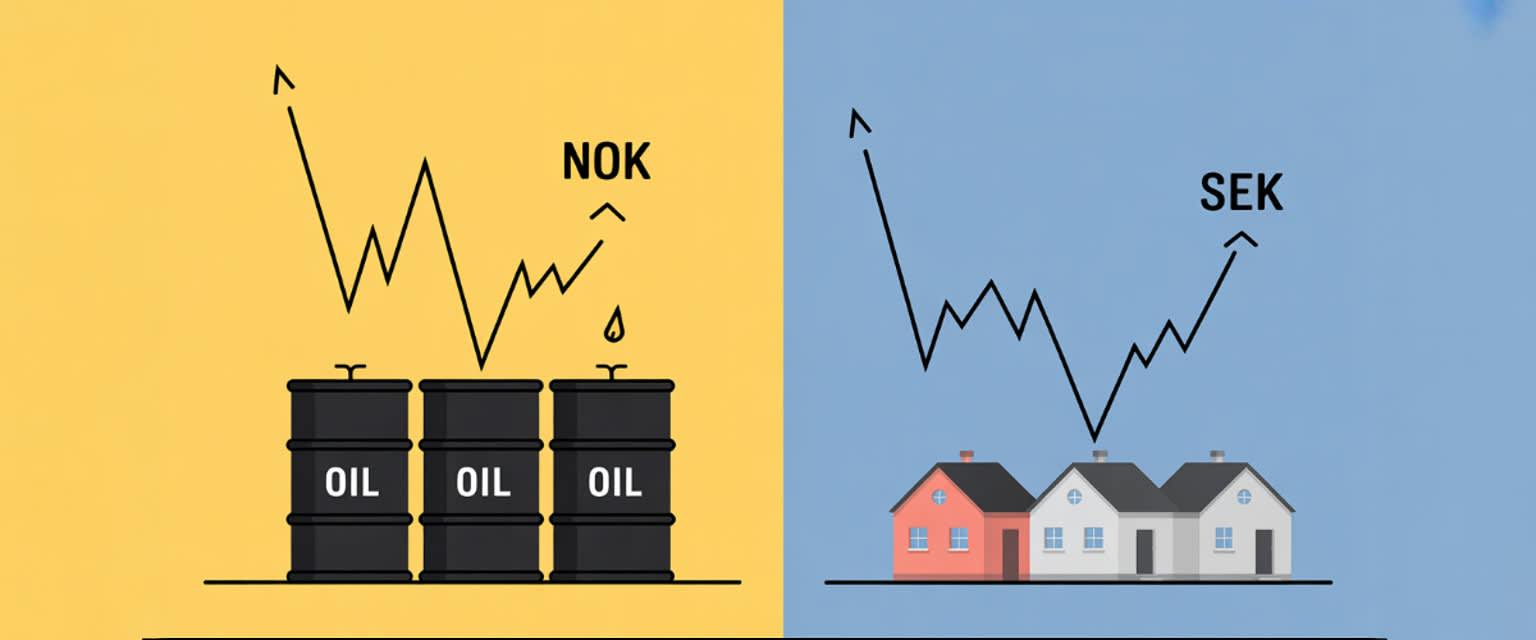
Norway's Commodity Anchor (NOK) : The Norwegian economy remains heavily exposed to global commodity cycles, primarily oil and gas. When global risk appetite increases, or when geopolitical events push up energy prices, the NOK often strengthens. This is due to the inherent link between Brent Crude Oil prices and Norway’s export revenue. Traders interested in the NOK should always monitor the price action in Brent Crude Oil CFDs, as these movements often precede or accompany changes in the NOK’s valuation. This commodity link tends to provide a structural bid for the NOK that is absent for the SEK.
Sweden’s Sensitivity to Global Demand and Housing (SEK) : The Swedish economy is significantly more reliant on manufacturing exports and is highly susceptible to the health of the Eurozone and global trade. Furthermore, as noted, the housing sector remains a major vulnerability. A downturn in global demand, or a persistent domestic housing slump, tends to have a disproportionately negative impact on the SEK. In periods of global risk aversion, or "flight to safety," the SEK often suffers more than the NOK because it lacks the stabilising commodity anchor. Traders may observe this difference reflected in the relative performance of EUR/NOK versus EUR/SEK during periods of high market uncertainty.
The divergence is thus a battle between a commodity-backed, generally more restrictive monetary policy (NOK strength drivers) and an export-driven economy constrained by a fragile housing market and a more cautious central bank (SEK weakness drivers).
Main Analysis: Arbitrage Illusion vs. Macro Trap
Given the historical correlation, many traders look at the NOK/SEK cross-rate and instinctively see a mispricing that must inevitably correct—an arbitrage. This perspective often proves to be the macro trap.
3. The Arbitrage Illusion in Spot FX
In classical finance, an arbitrage opportunity is a risk-free profit derived from a price difference in two or more markets. A sustained divergence between two currencies, however, is rarely a true risk-free arbitrage.
Fundamental Justification : The current wide divergence between the NOK and SEK tends to be fundamentally justified by the sustained and widening policy divergence between Norges Bank and the Riksbank. When policy and macro drivers are pointing in opposite directions, the historical correlation becomes irrelevant. Betting against the divergence merely based on the past correlation is a high-risk directional bet, not a low-risk arbitrage.
The Cost of Carry : The interest rate differential heavily influences the cost of carry for holding positions. If a trader were to bet on a rapid reversion by buying the weaker currency (SEK) and selling the stronger (NOK), they tend to incur a negative daily carry cost due to the differential in overnight lending rates. Over an extended period, this negative carry can erode potential profits or significantly amplify losses if the divergence persists, transforming a "relative value" idea into a continuous drain on capital.
4. Identifying the Macro Trap
The primary macro trap for a CFD trader is entering a position based solely on the expectation of a "return to normal."
The Trap of Correlation Trading : Correlation does not guarantee causation, nor does it guarantee future repetition. In a macro-driven environment, the divergence can persist for quarters or even years. Traders who rush to short EUR/SEK (betting on SEK strength) simply because it is historically weak compared to EUR/NOK (betting on NOK weakness) tend to be exposed to sharp, macro-driven moves that run against their position.
The Role of Global Risk Sentiment : In recent times, when global equity markets and risk-on assets (such as major European Equity Index CFDs) have performed well, the NOK tends to benefit from its commodity link more effectively than the SEK, which may be more constrained by domestic housing concerns. Conversely, a sharp global sell-off can see both currencies fall, but the path back to stability may be quicker for the NOK due to its structural financial buffer. The trap is assuming both currencies will respond identically to a global event.
Experienced CFD traders tend to avoid this trap by acknowledging that the divergence is fundamentally sound until the central banks align their policies or the structural macro differences (oil vs. housing) cease to dominate the narrative.
Curious about Forex trading?
Use our free demo account to practise trading 70+ different Forex pairs without risking real cash.

Insights into CFD Trading the NOK/SEK Dynamic
Since the divergence is a high-risk, macro-driven phenomenon, the focus shifts entirely to risk-managed relative value trading rather than pure directional bets.
1. Relative Value Trading (Cross-Rate Focus)
Traders may isolate the NOK/SEK movement by simultaneously trading the two major Euro pairs, which allows them to hedge the broad EUR risk.
The Strategy : A trader may take a long position in a pair that represents the relative strength of the NOK and a short position in a pair that represents the relative weakness of the SEK. For example, simultaneously taking a long position in the EUR/SEK CFD and a short position in the EUR/NOK CFD (with careful attention to sizing) is equivalent to a long position in the NOK/SEK cross-rate. This approach attempts to profit specifically from the differential in movement between the two Scandinavian currencies, reducing the impact of overall Euro strength or weakness.
Execution Insight : Success in this relative trade tends to rely on tight position sizing and understanding the leverage inherent in CFDs. The trader typically monitor Norges Bank and Riksbank news constantly; an unexpected shift in rhetoric from either bank can cause a sharp, divergent move that invalidates the relative position.
2. Momentum and Policy Trend Following
Instead of fighting the divergence by betting on reversion, traders often opt to follow the prevailing monetary policy trend.
The Strategy : Since Norges Bank tends to be more hawkish than the Riksbank, the trade is generally skewed toward NOK strength (SEK weakness). A trader may identify key technical levels in the EUR/SEK CFD that represent structural resistance (where the SEK has historically struggled to strengthen) and look for potential continuation patterns for a weaker SEK. Conversely, they may look for support levels in the EUR/NOK CFD to exploit any temporary NOK weakness that appears disconnected from the oil price and Norges Bank rhetoric.
Risk Mitigation : Due to the lower liquidity of these pairs compared to majors like EUR/USD, sudden price gaps are a significant risk. Traders tend to use mandatory Guaranteed Stop-Loss orders (GSLO) to ensure the maximum potential loss on the position is strictly defined, protecting capital from sudden, policy-driven spikes. Furthermore, traders may use tight position sizing to limit the overall capital at risk, which protects the trading account from the high volatility typical of cross-rates.
Tools/Platform: Skilling for CFD Trading
The sophisticated nature of trading currency crosses like NOK/SEK requires a robust and reliable trading platform. Skilling may offer traders access to a comprehensive range of relevant financial instruments, including the highly sensitive EUR/NOK CFDs and EUR/SEK CFDs, as well as associated assets like Brent Crude Oil CFDs.
The platform tends to provide competitive spreads and efficient trade execution, which is crucial for relative value strategies where the speed and cost of opening and closing simultaneous positions can impact overall profitability. Skilling’s advanced charting tools assist traders in conducting complex technical analysis, allowing them to plot the divergence and identify critical support and resistance levels. Furthermore, Skilling’s commitment to providing comprehensive risk management features, including various order types, helps traders implement the disciplined approaches necessary to navigate the high-risk environment of macro-driven currency divergence.
Conclusion: Key Takeaways
The NOK/SEK divergence is a powerful macro narrative driven by deep structural differences and contrasting monetary policies between Norway and Sweden. It is a reflection of Norges Bank’s commitment to its commodity-backed mandate and the Riksbank’s necessary caution concerning its domestic housing market.
For the CFD trader, the situation is not a straightforward arbitrage but a complex relative value environment. Success tends to lie not in betting on a rapid correction, which often proves to be a macro trap, but in understanding and respecting the current macro drivers. Traders may focus on disciplined strategies, such as relative value trading on the EUR/NOK and EUR/SEK pairs to isolate the cross-rate movement, and consistently use robust risk management tools like tight position sizing and Stop-Loss orders. The key is vigilance: the divergence will only end when Norges Bank and the Riksbank find common ground on their policy paths, or when the fundamental macro differences cease to be the primary market drivers.
Why miss out on the commodities market's potential?
Discover the untapped opportunities in top traded commodities CFDs like gold, silver & oil.

FAQs
1. What financial instruments are most affected by the NOK/SEK divergence?
CFD traders are primarily affected by the EUR/NOK and EUR/SEK currency pairs, and the resulting NOK/SEK cross-rate. Additionally, Brent Crude Oil CFDs are relevant due to their influence on the Norwegian Krone.
2. What is the main factor driving the current NOK/SEK divergence?
The primary driver is the significant and sustained interest rate differential between Norges Bank and the Riksbank. This is compounded by Norway's commodity-linked economy (oil) versus Sweden's greater vulnerability to its housing market and global export demand.
3. Is the NOK/SEK divergence a true arbitrage opportunity?
No, it is generally a macro-driven divergence, not a risk-free arbitrage. Traders tend to view it as a high-risk relative value trading situation where the divergence is fundamentally justified, not a market mispricing.
4. What is a key risk management insight for trading this divergence?
Due to the high volatility and potential for sudden moves driven by central bank announcements, traders tend to use tight position sizing and mandatory Guaranteed Stop-Loss orders to protect their capital from sharp, adverse price action.


