


[[ data.name ]]
[[ data.ticker ]]
[[ data.price ]] [[ data.change ]] ([[ data.changePercent ]]%)
Low: [[ data.low ]]
High: [[ data.high ]]
Overview
Related Markets
Trading Insights
Overview
Related Markets
Trading Insights
The Brent crude oil price is a global benchmark for oil markets, widely used to price crude exports across Europe, Africa, and parts of Asia. Represented as XBRUSD, it reflects the price of Brent crude oil in US dollars per barrel.
Brent crude oil is known for its relatively low sulfur content and efficient refining characteristics. For some traders, it is broadly regarded as a highly liquid commodity with frequent price movements driven by macroeconomic trends, supply conditions, and geopolitical developments.
Market Overview
Brent crude oil is primarily traded through futures contracts on the Intercontinental Exchange. The XBRUSD price represents the global benchmark rate for this commodity and is quoted in US dollars per barrel.
Key market participants include:
- Oil producers and exporters
- Commodity trading firms
- Institutional investors and hedge funds
- Retail traders using CFDs
As a benchmark, Brent crude oil price movements often reflect broader conditions in the global oil market.
What Moves the Brent Crude Oil Price
The Brent crude oil price is generally influenced by several key drivers:
- Geopolitical developments: Events such as Iran–US conflict can disrupt oil supply and increase market uncertainty, particularly if key routes like the Strait of Hormuz are affected.
- OPEC+ production decisions: Output adjustments from OPEC+ directly impact global supply levels.
- Global demand trends: Economic activity, industrial production, and transportation demand influence oil consumption.
- Inventory data: Changes in crude oil stockpiles provide insight into short-term supply and demand conditions.
- US dollar movements: Since oil is priced in the US dollar, currency strength can affect demand and pricing.
Factors Affecting Brent Crude Oil Price
The Brent crude oil price is typically shaped by a combination of structural and short-term factors:
Supply and demand balance
- Production cuts or disruptions can tighten supply
- Oversupply can lead to downward price pressure
Macroeconomic conditions
- Economic growth and industrial output
- Global trade activity
Energy policy and regulation
- Environmental policies impacting fossil fuel demand
- Long-term transition toward alternative energy
Technological developments
- Improvements in extraction and refining efficiency
- Increased production capacity
Market sentiment and speculation
- Futures positioning and trader expectations
- Short-term reactions to news and data
Trading Brent Crude Oil (CFDs)
Brent crude oil (XBRUSD) can be traded using CFDs, allowing traders to often speculate on price movements without owning the underlying commodity.
Key features:
- Ability to go long or short
- Use of leverage to adjust exposure
- Real-time execution based on market conditions
- Exposure to slippage during volatile periods
CFDs are often cited as commonly used to trade short-term price movements driven by economic data, geopolitical events, and technical signals.
Brent crude oil is closely connected to other oil-related markets:
Oil Benchmarks
- WTI crude oil (XTIUSD) – another major global oil benchmark
- Regional crude blends priced relative to Brent
Refined Products
- Gasoline
- Diesel
- Jet fuel
Oil Market Structure
- Upstream: exploration and production
- Midstream: transportation and storage
- Downstream: refining and distribution
These related markets help provide context for Brent crude oil price movements and overall energy market conditions.
How Traders Analyse Brent Crude Oil
Traders typically combine:
Fundamental analysis
- OPEC+ decisions
- Inventory data
- Geopolitical developments
Technical analysis
- Brent crude oil price chart patterns
- Support and resistance levels
- Indicators such as moving averages and RSI
Risk Considerations
Trading Brent crude oil involves specific risks:
- High sensitivity to geopolitical events
- Sudden supply disruptions
- Volatility during economic and inventory releases
- Leverage increases both gains and losses
Portfolio Use Cases
Brent crude oil is historically used to:
- Trade macroeconomic trends
- Gain exposure to energy markets
- Diversify a commodity-focused portfolio
- Respond to short-term volatility
Conclusion
The Brent crude oil price (XBRUSD) is a key indicator of global energy market conditions. Its movements reflect the balance between supply, demand, and broader economic factors.
By understanding its price drivers and applying structured analysis, traders can better navigate Brent crude oil markets and consider incorporating this instrument into their trading strategies.
| Swap long | [[ data.swapLong ]] points |
|---|---|
| Swap short | [[ data.swapShort ]] points |
| Spread min | [[ data.stats.minSpread ]] |
| Spread avg | [[ data.stats.avgSpread ]] |
| Min contract size | [[ data.minVolume ]] |
| Min step size | [[ data.stepVolume ]] |
| Commission and Swap | Commission and Swap |
| Leverage | Leverage |
| Trading Hours | Trading Hours |
* The spreads provided are a reflection of the time-weighted average. Though Skilling attempts to provide competitive spreads during all trading hours, clients should note that these may vary and are susceptible to underlying market conditions. The above is provided for indicative purposes only. Clients are advised to check important news announcements on our Economic Calendar, which may result in the widening of spreads, amongst other instances.
The above spreads are applicable under normal trading conditions. Skilling has the right to amend the above spreads according to market conditions as per the 'Terms and Conditions'.
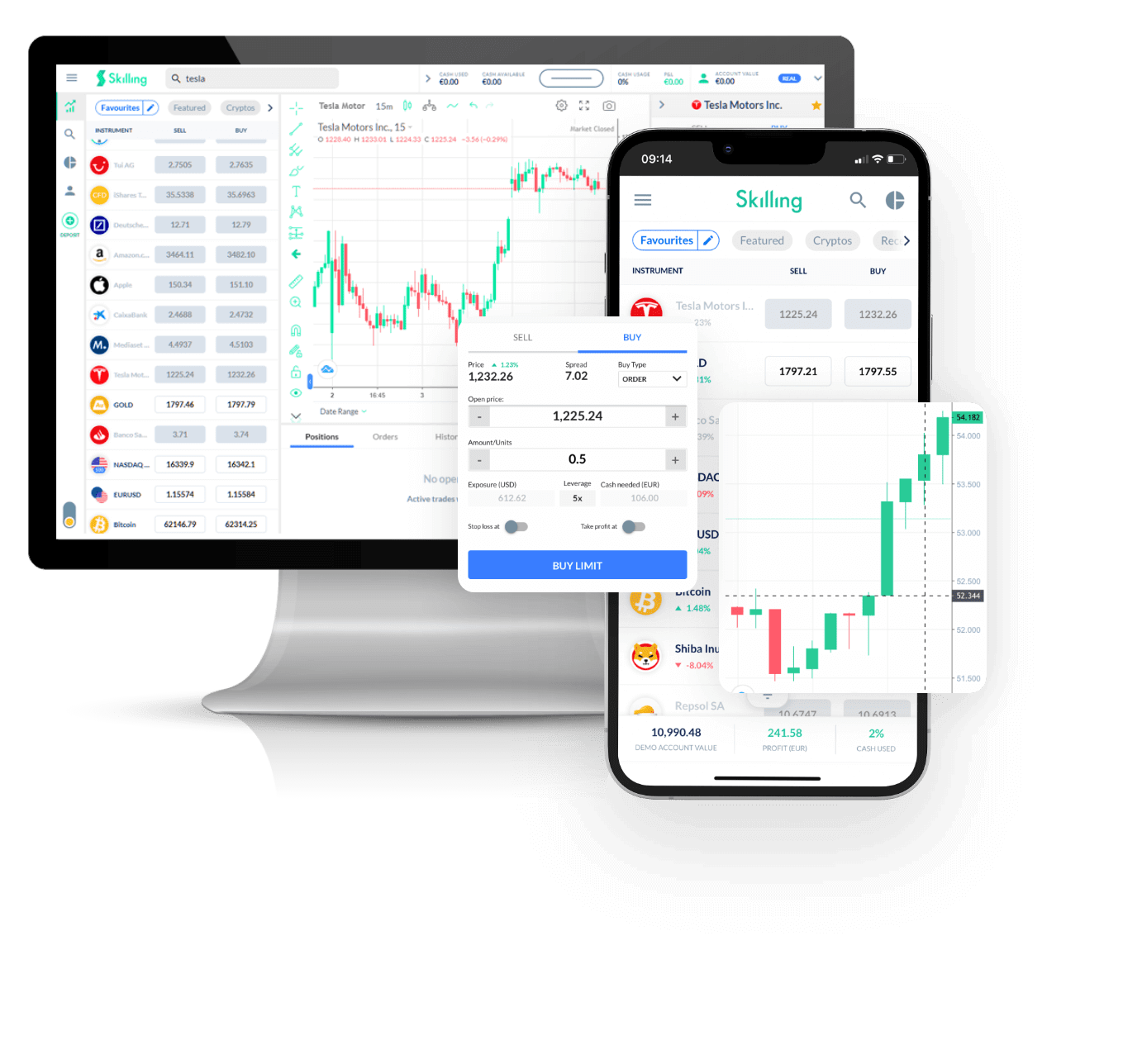
Trade [[data.name]] CFD with Skilling
Take a view on the commodity sector! Diversify with a single position.
- Trade 24/5
- Tight spreads
- Average Execution at 5ms
- Easy to use platform
FAQs
what is difference between Brent and crude oil?
Brent oil and WTI, or West Texas Intermediate oil, are two of the most commonly traded grades on the global market. The major difference between brent and wti is that brent oil is considered to be a benchmark for the majority of oils used in Europe, while wti is largely considered to be indicative of the price those in North America play for crude. Additionally brent's acidic levels tend to be lower than those found in wti, making brent more desirable for traders. As such brent typically trades at a higher price than wti – a factor all traders should pay attention to when trading either grade.
What does Brent oil stand for?
Brent oil comes from fifteen different fields located off the coast of Europe, centered around four major areas including the North Sea, Brent, Forties, and Oseberg. The acronym brent stands for “Broken-Rock-Extracting-Northern-Taran”, referring to three of the largest locations in its production sector. Brent Oil is known for its lasting impact on light sweet crude oil markets and remains an important commodity in production sectors across Europe.
How to trade brent oil?
With this particular type of oil, investors often use CFDs (contracts for difference) to ensure they get the most from their trading activities. CFDs allow a trader to take a long or short position on brent oil, meaning they can make money off rising or falling prices depending on their strategy.
Why Trade [[data.name]]
Make the most of price fluctuations - no matter what direction the price swings and without the restrictions that come with owning the underlying asset.
CFD
Actual Commodities

Capitalise on rising prices (go long)


Capitalise on falling prices (go short)

Trade with leverage

Trade on volatility

No commissions
Just low spreads

Manage risk with in-platform tools
Ability to set take profit and stop loss levels