


[[ data.name ]]
[[ data.ticker ]]
[[ data.price ]] [[ data.change ]] ([[ data.changePercent ]]%)
Low: [[ data.low ]]
High: [[ data.high ]]
Overview
History
Financials & Drivers
Overview
History
Financials & Drivers
Storebrand ASA is a Nordic financial services group headquartered in Lysaker, Norway. The company provides pensions, life insurance, asset management, and banking services, with core operations in Norway and Sweden. Storebrand is listed on the Oslo Stock Exchange under the ticker STB and is part of the Nordic financial sector.
The company’s business model is centred on long-term savings and retirement solutions. Its offerings include defined contribution pensions, insurance products, mutual funds, and retail banking services. Storebrand serves both individual customers and institutional clients, including corporations and public sector entities, reflecting the structure of pension systems in the region.
Operations are organised into segments such as Savings, Insurance, and Guaranteed Pension, each contributing differently to earnings and risk exposure. Savings represents a growing share of earnings, supported by assets under management and fee-based income. Over time, Storebrand has reduced reliance on guaranteed products and shifted toward a more capital-light structure aligned with regulatory developments.
Sustainability is integrated into the company’s investment approach, with ESG criteria applied across portfolios and product development. Storebrand also continues to develop digital distribution and platform-based services to support efficiency and customer access.
Key Points
- Listed on the Oslo Stock Exchange under ticker STB
- Core markets include Norway and Sweden
- Segments include Savings, Insurance, and Guaranteed Pension
- Increasing focus on fee-based, capital-light operations
- ESG integration across investment processes
For CFD traders, Storebrand often reflects a diversified financial services group with exposure to long-term savings trends and broader market conditions.
Storebrand’s origins date back to 1767, when its earliest predecessor was established as a fire insurance provider. The company later expanded into life insurance, reflecting increasing demand for financial protection and structured savings solutions.
Throughout the 19th and 20th centuries, Storebrand developed into a central participant in Norway’s insurance market, building capabilities across life and non-life business areas. As financial markets evolved, the company underwent restructuring and consolidation, enabling expansion into banking and asset management.
A key development occurred with the acquisition of SPP, a Swedish pension and insurance provider, which strengthened Storebrand’s presence in Sweden and supported its role as a Nordic savings provider. This expansion increased exposure to defined contribution pension schemes and diversified revenue streams across markets.
In more recent years, Storebrand has transitioned its business model. The company has reduced exposure to guaranteed pension products and increased its focus on savings, asset management, and fee-based income. This shift reflects regulatory changes, capital efficiency considerations, and evolving customer preferences.
Sustainability has become an integrated part of the company’s strategy, with ESG principles incorporated into investment decisions and governance frameworks. At the same time, digitalisation has supported the development of more scalable and accessible financial services.
Key Milestones
- 1767: Origins in fire insurance
- Expansion into life insurance during the 19th century
- 1990s: Restructuring into a broader financial services group
- Acquisition of SPP: Expansion into Sweden
- Transition toward savings, asset management, and ESG integration
Storebrand today combines a long-established insurance background with a diversified and modern financial services model.
Storebrand’s financial profile reflects a combination of fee-based income, insurance-related earnings, and investment returns. A significant share of earnings is linked to assets under management, making revenue sensitive to market levels and long-term savings inflows.
The company’s segment structure, including Savings, Insurance, and Guaranteed Pension, allows it to balance recurring income with exposure to financial markets. Savings, in particular, contribute a growing share of earnings through management fees on pension and investment products.
Macroeconomic factors play a central role in shaping Storebrand’s performance. Interest rates influence investment returns and insurance liabilities, while equity market developments affect assets under management and related fee income. Broader economic conditions may also influence pension contributions and savings behaviour.
Storebrand operates within a regulated financial framework and reports under IFRS standards. Its capital position reflects regulatory requirements for insurance and financial institutions, supporting stability across market cycles.
Key Trading Drivers
- Interest rates: Influence returns and financial positioning
- Equity market levels: Affect assets under management and fees
- Pension inflows: Support recurring revenue streams
- Regulation: Shapes capital requirements and product structure
- Market volatility: Reflects short-term movements in financial assets
For CFD traders, Storebrand reflects both defensive and cyclical characteristics. Long-term savings flows tend to provide stability, while sensitivity to market levels and macroeconomic conditions indicates potential for price fluctuations, without implying any particular market outcome.
| Swap long | [[ data.swapLong ]] points |
|---|---|
| Swap short | [[ data.swapShort ]] points |
| Spread min | [[ data.stats.minSpread ]] |
| Spread avg | [[ data.stats.avgSpread ]] |
| Min contract size | [[ data.minVolume ]] |
| Min step size | [[ data.stepVolume ]] |
| Commission and Swap | Commission and Swap |
| Leverage | Leverage |
| Trading Hours | Trading Hours |
* The spreads provided are a reflection of the time-weighted average. Though Skilling attempts to provide competitive spreads during all trading hours, clients should note that these may vary and are susceptible to underlying market conditions. The above is provided for indicative purposes only. Clients are advised to check important news announcements on our Economic Calendar, which may result in the widening of spreads, amongst other instances.
The above spreads are applicable under normal trading conditions. Skilling has the right to amend the above spreads according to market conditions as per the 'Terms and Conditions'.
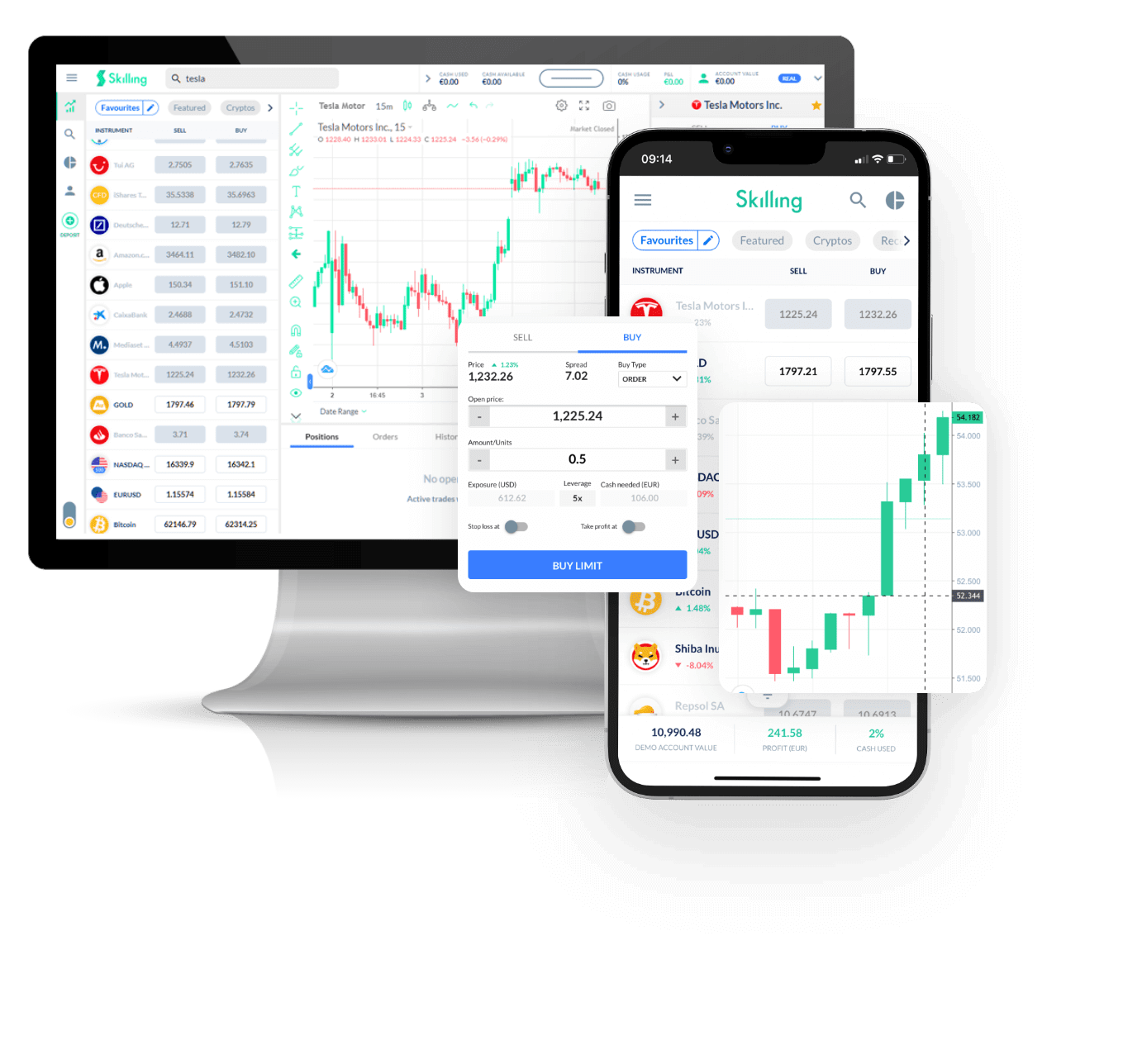
Trade [[data.name]] CFD with Skilling
All hassle-free, with flexible trade sizes and seamless trading experience!
- Check trading hours for this market
- Minimum margin requirements
- No commission, other fees may apply
- Easy to use platform
Why Trade [[data.name]]
Make the most of price fluctuations - no matter what direction the price swings and without capital restrictions that come with buying the underlying asset.
CFDs
Equities

Capitalise on rising prices (go long)


Capitalise on falling prices (go short)

Trade with leverage
Hold larger positions than the cash you have at your disposal

Trade on volatility
No need to own the asset

No commissions
Spreads and swaps apply. Other fees may apply.

Manage risk with in-platform tools
Ability to set take profit and stop loss levels