


[[ data.name ]]
[[ data.ticker ]]
[[ data.price ]] [[ data.change ]] ([[ data.changePercent ]]%)
Low: [[ data.low ]]
High: [[ data.high ]]
Overview
History
Financials & Drivers
Overview
History
Financials & Drivers
Assa Abloy B (ASSA B), listed on Nasdaq Stockholm Large Cap, operates as a global provider of access and security solutions. The company focuses on locking systems, door hardware, and digital access technologies used across residential, commercial, and institutional environments.
Its offering spans both traditional mechanical locks and advanced electromechanical systems, including access control, identification technologies, and automated entrances. This combination reflects a shift toward integrated security ecosystems, where physical and digital infrastructure increasingly overlap.
Geographically, Assa Abloy maintains a diversified revenue base, with strong exposure to Europe and North America, alongside a growing presence in Asia-Pacific and other international markets. This global footprint often contributes to varied demand drivers tied to construction activity, infrastructure investment, and security regulation.
From a structural perspective, the company operates through multiple divisions aligned with regional markets and product categories, supporting scalability and acquisition-driven expansion.
Key highlights:
- Listed on Nasdaq Stockholm (Large Cap) under ticker ASSA B
- Global supplier of locking and access solutions
- Exposure to residential, commercial, and institutional sectors
- Strong presence in Europe and North America
- Increasing focus on electromechanical and digital security
Assa Abloy was formed in 1994 through the merger of Swedish ASSA and Finnish Abloy, combining complementary expertise in locking technologies. This merger established the foundation for a group that would expand rapidly through both organic growth and acquisitions.
Since its formation, the company has pursued a consistent strategy of acquiring regional and specialised security businesses. Typically enabled entry into new markets and the expansion of its product portfolio, particularly in electronic access solutions and smart security systems.
Over time, Assa Abloy has transitioned from a primarily mechanical lock manufacturer into a broader access solutions provider. This evolution reflects wider industry trends, including digitalisation, automation, and increased demand for integrated building security.
The company’s development has also been shaped by its ability to integrate acquisitions efficiently, maintaining operational consistency while expanding its global reach.
Key milestones:
- 1994 merger of ASSA (Sweden) and Abloy (Finland)
- Expansion through frequent international acquisitions
- Shift from mechanical locks to digital access solutions
- Entry into smart security and automation technologies
- Strengthened global footprint across multiple regions
Assa Abloy’s financial model is based on a mix of product sales and value-added solutions, including installation, maintenance, and system integration. Revenue is supported by both new construction demand and aftermarket services such as upgrades and replacements.
Profitability metrics, including operating margin and return on capital employed, reflect a business with stable cash flow characteristics and exposure to long-term infrastructure trends. The company’s diversified operations contribute to resilience across economic cycles, although performance remains linked to construction activity and capital investment.
From a CFD perspective, several macroeconomic and sector-specific factors can generally form core parts of the share’s value and volatility. Interest rate changes have historically been observed to affect construction activity and financing conditions, while general equity market sentiment may influence valuation multiples.
Additionally, the ongoing transition toward digital access systems introduces both growth potential and investment requirements, which may affect margins and capital allocation over time.
Key trading drivers:
- Global construction and infrastructure activity
- Interest rate environment and financing conditions
- Demand for smart and digital access solutions
- M&A activity and integration outcomes
- Regulatory standards in building security and safety
| Swap long | [[ data.swapLong ]] points |
|---|---|
| Swap short | [[ data.swapShort ]] points |
| Spread min | [[ data.stats.minSpread ]] |
| Spread avg | [[ data.stats.avgSpread ]] |
| Min contract size | [[ data.minVolume ]] |
| Min step size | [[ data.stepVolume ]] |
| Commission and Swap | Commission and Swap |
| Leverage | Leverage |
| Trading Hours | Trading Hours |
* The spreads provided are a reflection of the time-weighted average. Though Skilling attempts to provide competitive spreads during all trading hours, clients should note that these may vary and are susceptible to underlying market conditions. The above is provided for indicative purposes only. Clients are advised to check important news announcements on our Economic Calendar, which may result in the widening of spreads, amongst other instances.
The above spreads are applicable under normal trading conditions. Skilling has the right to amend the above spreads according to market conditions as per the 'Terms and Conditions'.
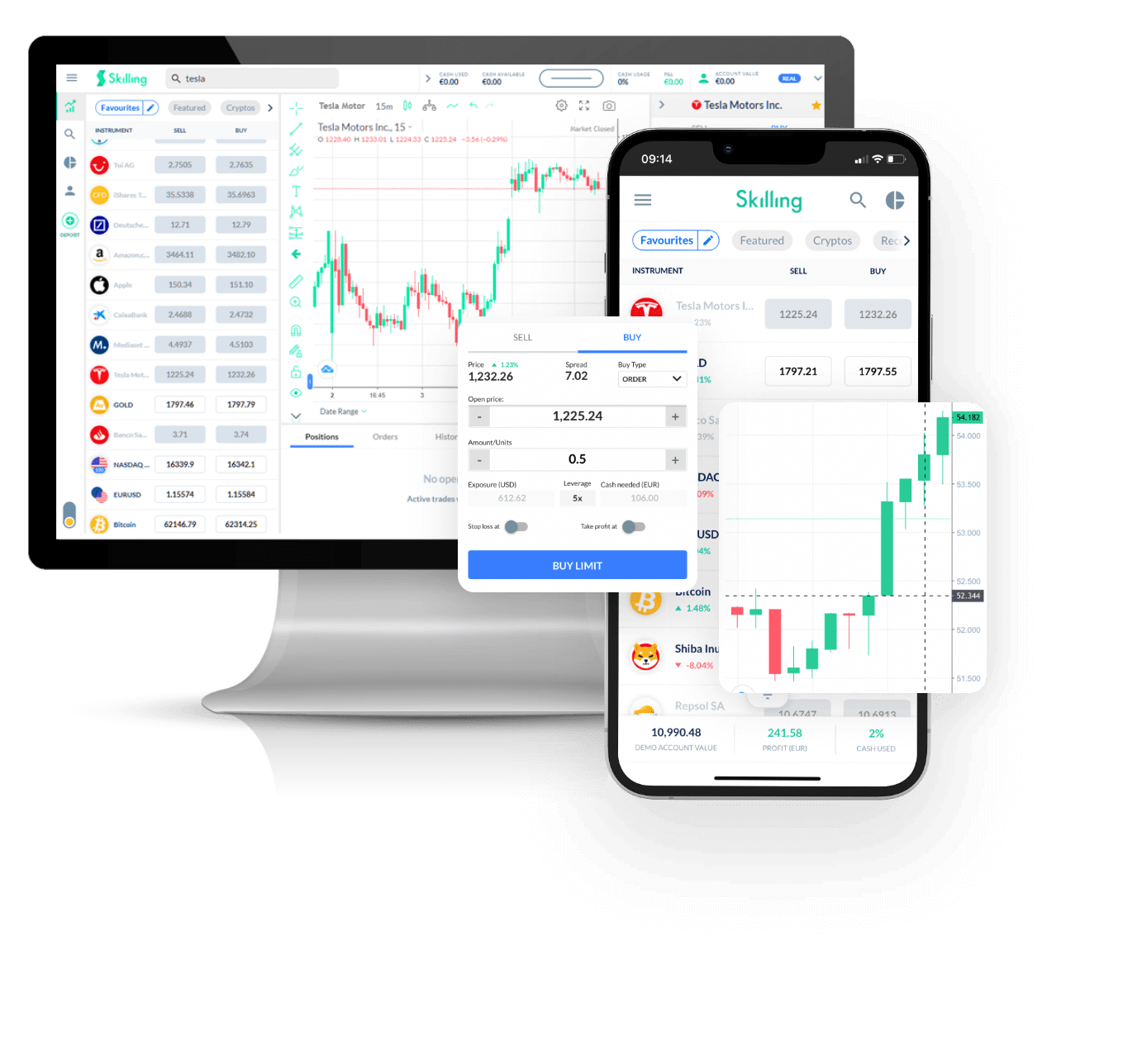
Trade [[data.name]] CFD with Skilling
All hassle-free, with flexible trade sizes and seamless trading experience!
- Check trading hours for this market
- Minimum margin requirements
- No commission, other fees may apply
- Easy to use platform
Why Trade [[data.name]]
Make the most of price fluctuations - no matter what direction the price swings and without capital restrictions that come with buying the underlying asset.
CFDs
Equities

Capitalise on rising prices (go long)


Capitalise on falling prices (go short)

Trade with leverage
Hold larger positions than the cash you have at your disposal

Trade on volatility
No need to own the asset

No commissions
Spreads and swaps apply. Other fees may apply.

Manage risk with in-platform tools
Ability to set take profit and stop loss levels