


[[ data.name ]]
[[ data.ticker ]]
[[ data.price ]] [[ data.change ]] ([[ data.changePercent ]]%)
Low: [[ data.low ]]
High: [[ data.high ]]
Overview
Related Markets
Trading Insights
Overview
Related Markets
Trading Insights
XRPUSD refers to the value of XRP quoted against the US dollar, making it one of the most actively traded cryptocurrency pairs in the digital asset market. XRP is the native token of the Ripple network, designed to facilitate fast and low-cost cross-border payments.
Unlike many cryptocurrencies, XRP focuses on financial institutions and payment providers rather than decentralised finance. Its rate is often influenced by both crypto market sentiment and developments related to Ripple’s technology and legal environment.
For traders, XRPUSD typically offers high liquidity, volatility, and frequent price movements, often considered relevant in short-term trading as well as macro-driven strategies.
Market Overview
XRPUSD is traded on cryptocurrency exchanges and CFD trading platforms, where its rate fluctuates continuously based on market demand.
Key characteristics:
- Quoted as XRP against USD (XRPUSD)
- Trades 24/7, unlike traditional financial markets
- High participation from retail traders and institutional participants
- Influenced by both crypto-specific and macroeconomic factors
The XRP ledger enables fast transaction settlement, which contributes to its adoption in cross-border payment solutions.
What Moves the XRPUSD Rate
Several factors influence XRPUSD price movements:
- Regulatory developments : Legal rulings, particularly in the US, have historically had a significant impact on XRP sentiment and valuation.
- Crypto market sentiment : XRP often follows broader cryptocurrency trends led by Bitcoin and Ethereum.
- Adoption of Ripple technology: Partnerships with banks and payment providers can influence demand for XRP.
- Supply dynamics: XRP has a pre-mined supply, with periodic releases from escrow affecting circulation.
- Macroeconomic environment: Interest rates, inflation, and USD strength can affect risk assets like cryptocurrencies.
- Exchange listings and liquidity: Availability on major exchanges influences accessibility and trading volume.
Factors Affecting XRPUSD Price
Additional elements shaping XRPUSD include:
- Market demand and liquidity : Increased trading volume can amplify price swings
- Institutional involvement : Greater adoption by financial institutions often impacts long-term value
- Technological developments : Improvements in the Ripple network or competing blockchain solutions
- Speculative trading activity : Short-term traders contribute to volatility
- Global payment trends : Demand for faster cross-border solutions can influence XRP relevance
Trading XRPUSD with CFDs
Trading XRPUSD with CFDs allows traders to speculate on price movements without owning the underlying cryptocurrency.
Key features:
- Ability to go long or short depending on market direction
- Use of leverage increases both potential returns and risk
- Access to XRPUSD rate movements without managing crypto wallets
- Trading is influenced by short-term volatility or longer-term trends
As with all leveraged products, risk management is essential due to rapid price fluctuations.
XRPUSD is closely connected to other cryptocurrencies and macro-related markets.
Store kryptovalutaer
- Bitcoin (BTCUSD) – often drives overall market direction
- Ethereum (ETHUSD) – influences altcoin sentiment
- Litecoin (LTCUSD) – another payments-focused cryptocurrency
Stablecoins and USD Dynamics
- USDT (Tether) and USDC affect liquidity flows in crypto markets
- USD strength can influence XRPUSD valuation
Blockchain & Payment Tokens
- Stellar (XLMUSD) – similar use case in cross-border payments
- Algorand (ALGOUSD) – infrastructure-focused blockchain
Risk Assets
Tech stocks and growth assets can correlate with crypto sentiment during risk-on periods
Understanding these relationships can help traders identify broader market trends and potential opportunities.
How Traders Analyse XRPUSD
Traders typically combine technical and fundamental analysis:
Technical analysis
- Support and resistance levels
- Trend lines and chart patterns
- Indicators such as RSI, MACD, and moving averages
Fundamental analysis
- Regulatory updates
- Ripple partnerships and adoption
- Developments in the crypto ecosystem
Trading Tools and Approaches
Common tools used when trading XRPUSD:
- Candlestick charts for price action
- Volatility indicators to assess risk
- Volume analysis to confirm trends
- News monitoring for sudden market shifts
Risk Considerations
Trading XRPUSD involves specific risks:
- High volatility compared to traditional assets
- Sensitivity to regulatory news
- Rapid sentiment shifts in crypto markets
- Leverage increasing exposure to losses
Using stop-loss orders and position sizing is critical when trading CFDs.
Portfolio Use Cases
XRPUSD can be used in a portfolio to:
- Gain exposure to the cryptocurrency market
- Trade short-term volatility
- Diversify beyond traditional asset classes
- Hedge against fiat currency movements in certain scenarios
Conclusion
XRPUSD remains a widely traded cryptocurrency pair, influenced by a combination of regulatory developments, market sentiment, and technological adoption. Its volatility and liquidity make it relevant for active traders, particularly when considered alongside structured analysis and disciplined risk management.
| Swap long | [[ data.swapLong ]] points |
|---|---|
| Swap short | [[ data.swapShort ]] points |
| Spread min | [[ data.stats.minSpread ]] |
| Spread avg | [[ data.stats.avgSpread ]] |
| Min contract size | [[ data.minVolume ]] |
| Min step size | [[ data.stepVolume ]] |
| Commission and Swap | Commission and Swap |
| Leverage | Leverage |
| Trading Hours | Trading Hours |
* The spreads provided are a reflection of the time-weighted average. Though Skilling attempts to provide competitive spreads during all trading hours, clients should note that these may vary and are susceptible to underlying market conditions. The above is provided for indicative purposes only. Clients are advised to check important news announcements on our Economic Calendar, which may result in the widening of spreads, amongst other instances.
The above spreads are applicable under normal trading conditions. Skilling has the right to amend the above spreads according to market conditions as per the 'Terms and Conditions'.
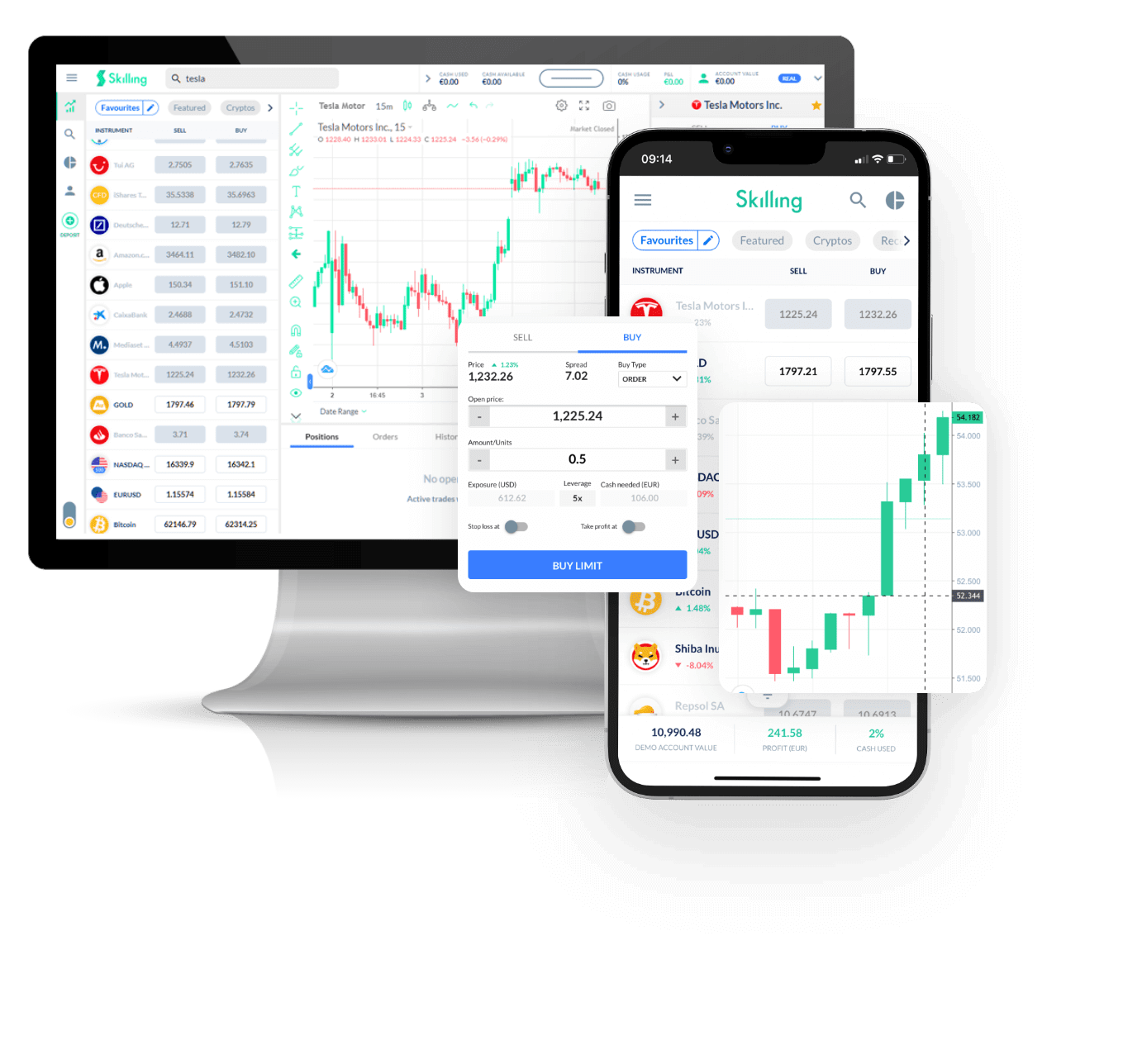
Trade [[data.name]] CFD with Skilling
The most popular and trending cryptocurrencies, all in one place at the right time.
- Trade 24/7
- Minimum margin requirement below ~3$
- Spreads of just $0.50 on BTC - lower on other crypto! Plus a super low trading fee of 0.1%/side
- No withdrawal fees
- Diversify! 900+ instruments to choose from
FAQs
How to trade Ripple?
For individual investors, Ripple can be bought and sold on a number of different exchanges using various trading strategies. One popular strategy is to trade Ripple against the Euro (XRP/EUR). This pair represents the value of one Ripple in Euros and can be bought and sold on many major cryptocurrency exchanges. When trading Ripple, it is important to keep an eye on news related to both the digital asset and the Eurozone economy as these can have a big impact on the XRP/EUR pair.
When was Ripple released?
Released in 2012, Ripple is built on a distributed ledger database that allows for a secure, decentralized way of making and receiving payments. Unlike other digital assets such as Bitcoin, Ripple is not intended to be used as a currency but rather as a means of facilitating payments between different fiat currencies. As such, it is one of the few digital assets that is currently being used by financial institutions for real-world applications.
What is the future of Ripple?
Although Ripple has been around since 2012, it has only recently gained mainstream attention. Despite this, Ripple has a bright future ahead. The team behind Ripple is constantly working on new projects and partnerships that will increase the use of the Ripple network and XRP.
In addition, many experts believe that Ripple has the potential to revolutionize the way we send money around the world. As a result, there is a lot of excitement around Ripple and its future prospects. So far, Ripple has exceed expectations and it seems likely that this trend will continue in the years to come.
Why Trade [[data.name]]
Make the most of price fluctuations - no matter what direction the price swings and without capital restrictions that come with buying the underlying crypto asset.
Crypto CFD
Physical Crypto

Capitalise on rising stock prices (go long)


Capitalise on falling crypto prices (go short)

Trade with leverage
Hold larger positions than the cash you have at your disposal

Trade on volatility
No need to own the asset or have an exchange account

No exchange fees or complex storage costs
Just lower commissions in the form of spreads and a small taker-fee

Manage risk with in-platform tools
Ability to set take profit and stop loss levels